
The Quiet Before the Restoration: Why Lititz Springs Park Events Restrictions
After 200-year-old trees, a flooded flood plain, and too many bare patches of grass, the park board made a call that will reshape the town’s event calendar — indefinitely.
For generations, Lititz Springs Park Events Restrictions has been the beating heart of one of Pennsylvania’s most charming small towns — a shaded, spring-fed sanctuary where festivals crowded the lawns, food trucks lined the paths, and the scent of funnel cake drifted past trees that were already old when the Civil War began.
That version of the park is going on pause.
In August 2025, the Lititz Springs Park Board of Trustees announced that starting in 2026, no large events would be held on the grounds — and unlike most park announcements, this one came with no end date attached. The reason, the board said, was simple and visible to anyone who’d spent time there recently: the park was quietly falling apart.
A flood plain pushed too far
Lititz Springs Park sits in a uniquely vulnerable spot. Before it became a beloved community green space, the land was a swamp — and it hasn’t forgotten that. The park serves as the flood plain for the entire borough of Lititz, designed to absorb the town’s overflow water. In July 2025, just days before the park’s iconic Fourth of July celebration, it was submerged. Volunteers drained it by hand to make the event possible.
Board president Rich Motz has watched the damage compound since taking the role three years ago. In that time, some grassy areas have sunk by six inches. The lush green lawns visible in old photographs have given way to bare, compacted soil — the result of thousands of feet crossing the same ground year after year.
“Every time we have a large gathering, those roots get some damage. We want to preserve those roots so those trees don’t die. We have some over here by the stream that date back to the Civil War.”
The trees themselves are the park’s most irreplaceable asset — and its most fragile. Large events bring not just crowds but staging areas, vendor setups, and equipment. That kind of pressure compacts soil around root systems in ways that don’t show up immediately, but accumulate. Lose a tree that’s been standing since 1863, and there’s no replanting your way back.
What the restoration actually means
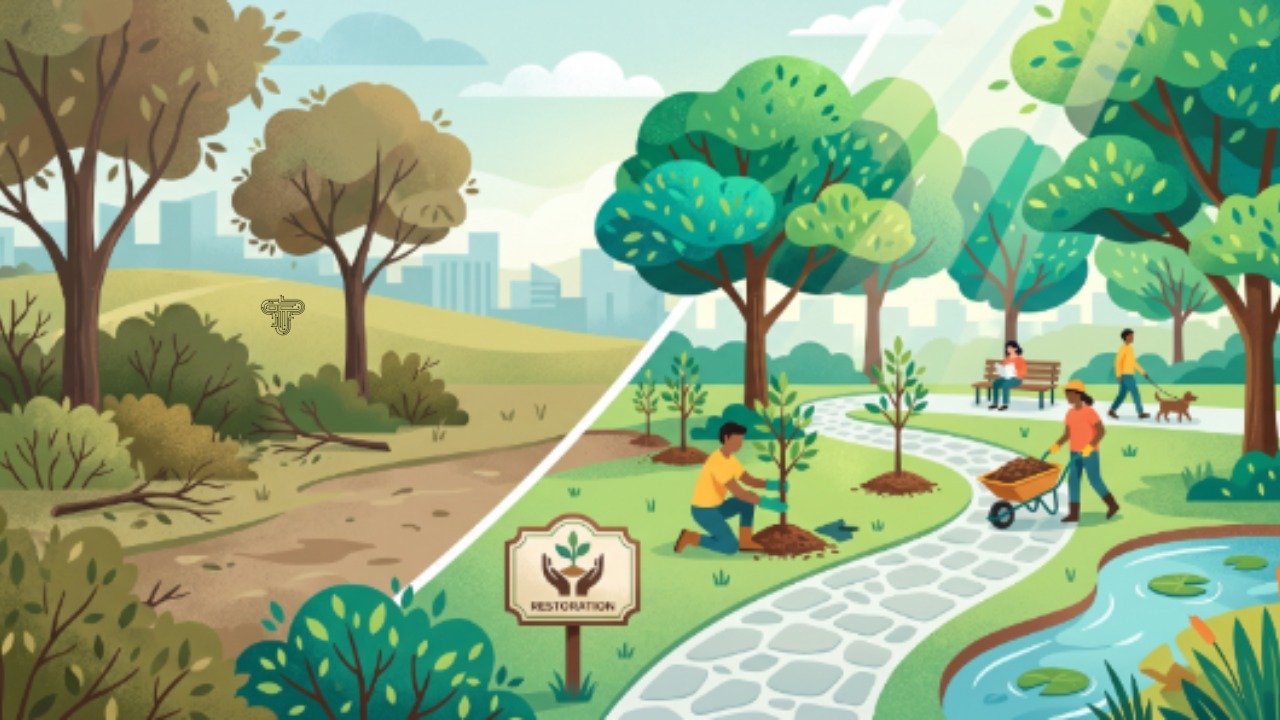
The project will unfold in phases, addressing the park’s infrastructure from the ground up. Drainage improvements in swale areas, refurbishments to bridges and stream walls, new walking paths, and the planting of native species are all on the plan. The sports field adjacent to the park is set to be converted into a nature preserve — a swale area designed to absorb floodwater and support wildlife, with walking trails through it.
The board has been deliberate about not over-promising. No timeline has been set. No milestone has been named at which large events would be welcomed back. The language from trustees is careful: this is about restoring the park “to its full potential,” and that work will take as long as it takes.
What’s still happening in the park
- Annual Fourth of July celebration (sole fundraiser & contractual requirement)
- Kiwanis Kid’s Day
- Community Vespers services
- Lititz Farmers Market
- Christmas in the Park
- Standard facility rentals (with park rules & possible Borough approval)
The one exception, and why it makes sense
The Fourth of July celebration will continue — as it has, with few exceptions, for over 208 years. That might look like a contradiction: the park is too fragile for large events, but not for its largest one?
The board acknowledges the tension directly. The July 4th event brings heavy foot traffic, they say, but it also generates the only reliable revenue stream the park has. That money funds the reseeding, tree care, and path maintenance that follows in its wake. Without it, the restoration project itself would be harder to fund.
There’s also a legal dimension. Lititz Springs Park is privately owned — by the Lititz Moravian Congregation — and managed by the Churches of Lititz under an operating agreement. That agreement explicitly requires the annual Fourth of July celebration to continue “in a manner and form which will be in keeping with the history and traditions of the celebrations and the community of Lititz.” It’s not just a tradition. It’s a contractual obligation.
What this means for event organizers
For anyone who has hosted — or hoped to host — an event at Lititz Springs Park, the practical picture has changed significantly. The park still accepts standard rentals, but the framework is tighter than it may once have seemed.
Organizers should approach the park as a private venue with fixed rules, not an open public festival space. Commercial or for-profit activities require Park Board approval at least a month in advance, plus a Certificate of Liability Insurance naming Lititz Springs Park, Inc. as an additional insured. Larger public events require a second layer of approval from Lititz Borough — making planning a two-step process that takes time.
All event organizers affected by the 2026 changes were notified at the end of their 2024 events, giving them nearly two full years to find alternatives. Conversations are already underway with community stakeholders to identify other venues in Lititz so the economic impact of those events stays local.
Tech Blaster
A town reckons with its green heart
Lititz has always been proud of its park in the way that small towns are proud of things that feel irreplaceable. The springs, the trees, the walking paths — they aren’t just amenities. They’re part of the town’s identity, a living connection to its Moravian roots and 18th-century founding.
That’s precisely why the board felt the restrictions were necessary. A park that gets loved to death isn’t preserved — it’s lost slowly, one bare patch at a time. The restoration is, in its way, an act of faith: that by pulling back now, the park will be worth coming back to for another 200 years.
The trees that survived the Civil War are still standing. The goal is to make sure they survive this century too.